How to create a welcoming environment for multilingual students. You may receive English learners from different cultures and family values in your classroom. These children are adjusting to new ways of doing and saying things. As their teacher, you are an important bridge to help them transition smoothly.
But first, we have to discuss important aspects that can affect multilingual students, especially newcomers. Here are some tips and a free resource I created for you to use in your classroom.

First, let’s talk about important facts:
- Based on the National Center for Education Statistics, multilingual learners now make up more than 10% of the US student population, including students born in the US and those who have immigrated or moved here.
- More than 75% of multilingual learners speak Spanish, and many schools and districts have more than 100 languages represented among their students.
- There are 67.3 million people in the US who are bilingual or multilingual, according to the Center for Immigration Studies, or 20.6% of the population.
- English learners (ELs) are a growing part of the K–12 student population.
Second, let’s talk about how teachers feel about supporting multilingual students.
In my experience working in different roles as a teacher and as a multilingual support, I see many teachers who feel unsupported or frustrated about ELL students. For the majority of teachers, their workload is heavy. Therefore, teachers might perceive multilingual students as having to do more work to help them.
“Many teachers in rural and urban schools feel inadequately prepared to support multilingual students’ success due to lack of research-based knowledge about culturally sustaining teaching and differentiated instructional strategies that benefit all learners”, (Adams, 2018; Coady, 2020; Hansen-Thomas et al., 2016).

Next, let’s talk about cultural accommodation.
Cultural accommodation happens as an individual adjusts to a new culture while remaining part of their parent’s culture. There are common stages that newcomers experience when they arrive in a new country. It is important to learn how these stages affect your students to support them better in the classroom.
- Stage 1: The Excitement or Euphoria Stage
- This first stage is when the individual faces a “cultural shock”. Everything feels new and interesting and it’s usually a positive stage. The person is curious about everything they see and experience. Usually, the students are eager to learn English.
- Stage 2: The Cultural Shock or Frustration Stage
- After they go through a happy and positive stage of living in a new culture, they enter a less favorable stage. They start to feel frustrated, homesick, angry, or anxious about the difficulties of adapting to the new language, and behavior of local people, which includes teachers and classmates. As a teacher, you will notice how students don’t understand what many people say.
- Stage 3: The Adjustment Stage
- After going through the excitement and frustrations of the first two stages, the person moves to a new stage of adjusting. The individual is learning a new language and has more knowledge about the new country and the school system. In this stage, students are beginning to feel more at home.
- Stage 4: The Acceptance/Adaptation Stage
- This is a stage in which the individual accepts that it is okay to adapt to a new life in a different country. They embrace and adapt to the new language and the people around them.
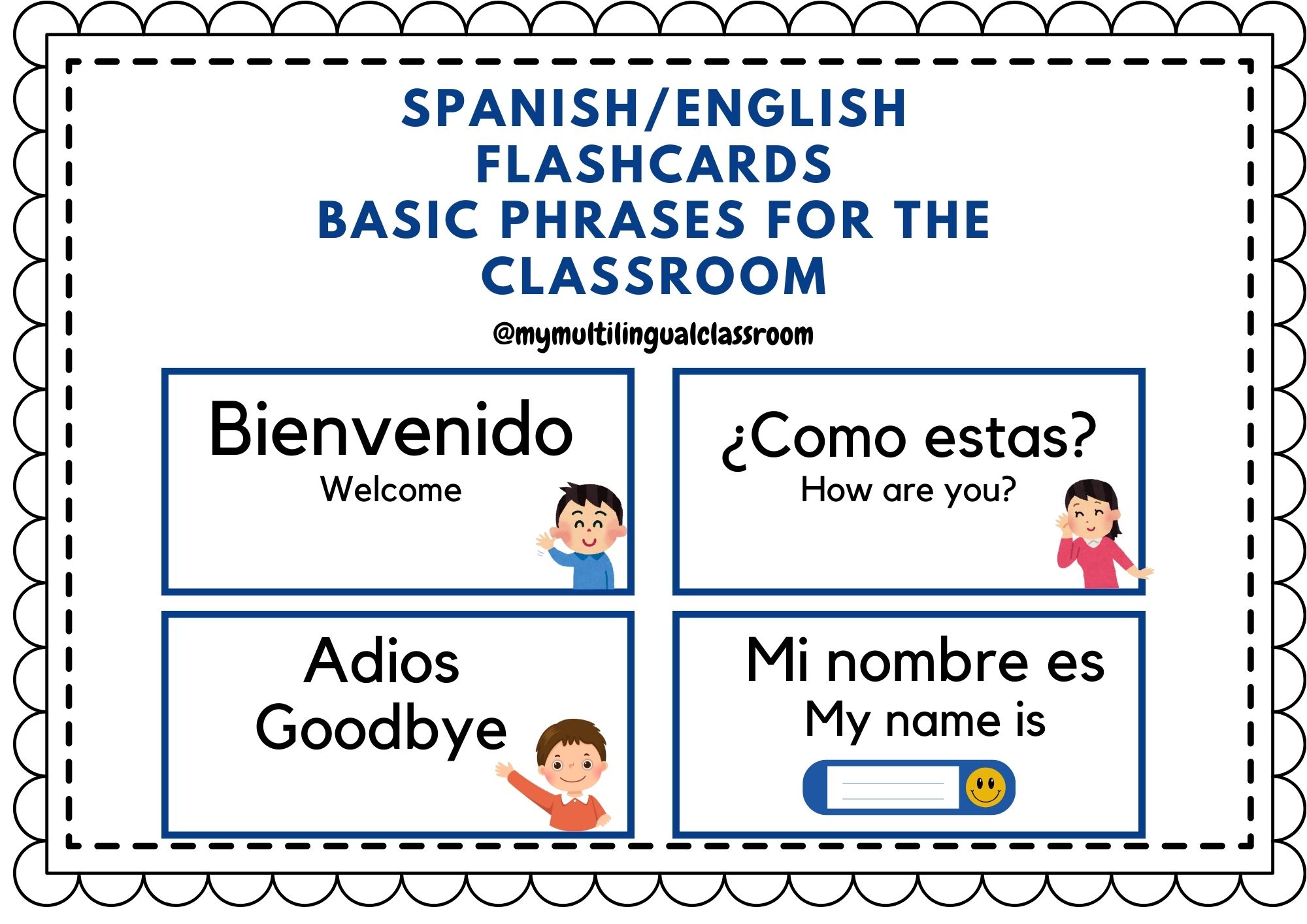
Free Spanish/English Flashcards
Here’s a free recourse that a created to help your multilingual students. These cards are a great way for newcomers to use during the day. They are also helpful for teachers to be able to communicate with the student.
Click to download: Second Language Learners Flashcards

What classroom strategies can help ELL students to adapt to a new environment?
Each learner brings their identity, culture, and unique ways of viewing the world into the classroom. Their experiences enrich the learning environment and foster a global perspective among classmates. Although there are no specific teaching techniques to make ELL/Multilingual students feel at home, there are many ways for you to make them feel welcome in your classroom.
These are some examples:
- Flashcards – Create flashcards for students to use as tools for oral communication. These flashcards that I created can be used by students inside a folder or on a key chain. They include basic words and phrases in Spanish and English to facilitate basic needs and daily routines.
- Translators – These are great and helpful but they can take away social interaction and oral communication.
- Labels – Labeling the classroom in different languages helps the student adapt to the class.
- Learn their names and the correct pronunciation. Ask them to say their names and make an effort for everyone to learn the correct pronunciation.
- Post a visual schedule – Post a schedule with pictures and labels in their language.
- Invite their culture into your classroom – Encourage ELL students to share their language and culture with you and others. Show and Tell is a great way to incorporate cultural responsiveness in the classroom. They can read a cultural book, make art, teach their language, have cooking classes, and invite family members to talk about their culture.
- Physically model language to ELLs in classroom routines and instructional activities. ELLs will need to see you or their peers’ model behavior when you want them to sit down, walk to the bulletin board, work with a partner, copy a word, etc.
Be consistent, patient, and fair with all students. Once multilingual students understand what is expected, hold them equally accountable for their behavior. In my next newsletter, we will discuss other strategies you can use with multilingual students and a new resource.
References
Novice general education teachers’ perceptions of preparedness in U.S. public schools: The impact of learning about and working with multilingual students Teaching and Teacher Education – Volume 116 August 2022, 103757

Leave a Reply